
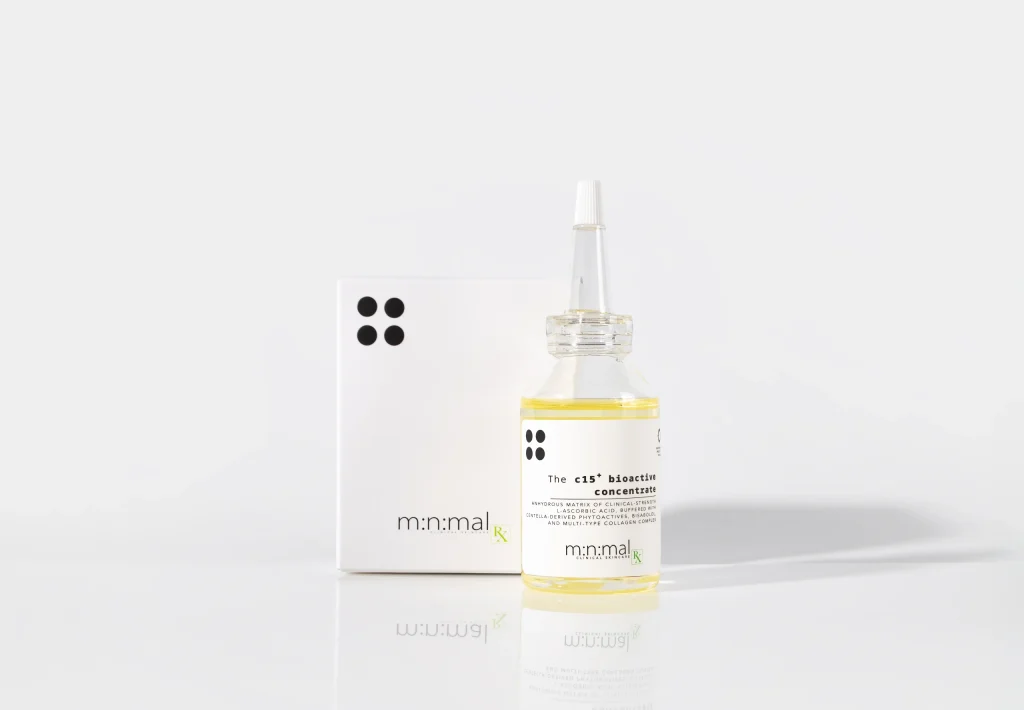
Vitamin C is one of the best-studied ingredients in skincare, and one of the hardest to keep working. C15+ is built around that problem.
Why L-ascorbic acid
Vitamin C comes in many forms, but L-ascorbic acid is the one the skin uses directly. Derivatives such as sodium ascorbyl phosphate are more stable, but the skin must convert them first, and results are generally more modest.
In skin, L-ascorbic acid does three well-documented jobs:
- It neutralises free radicals created by UV and pollution.
- It is a cofactor for the enzymes that build collagen.
- It interferes with melanin formation, helping to even tone.
The problem: water
L-ascorbic acid breaks down quickly in water, especially with air, light and heat. It oxidises to dehydroascorbic acid and then further, and the serum turns yellow, then orange or brown. An oxidised serum has lost much of its activity.
Most vitamin C serums fight this with a very low pH, antioxidant partners and dark packaging. Those help, but they can also make a serum sting.
Our approach: remove the water
C15+ is anhydrous: its base is propanediol, not water. With no water to react in, L-ascorbic acid stays in its active form for longer. That also let us include calming ingredients (betaine and bisabolol) to offset the sensitivity strong vitamin C can cause.
C15+ contains 25.5% L-ascorbic acid, as printed on the ingredient list. A landmark 2001 study found skin uptake from a water-based serum rose with concentration up to 20%. C15+ uses a different, water-free base.
Getting the most from C15+
- Build up slowly. Start once daily or on alternate nights if you are new to vitamin C or have sensitive skin.
- Use sunscreen. Vitamin C complements sunscreen; it doesn’t replace it.
- Watch the colour. If any vitamin C serum turns dark orange or brown, it has oxidised.
- Use within 3 months of opening. Store it somewhere cool, dry and dark.
Further reading
- Pinnell SR, Yang H, Omar M, et al. Topical L-ascorbic acid: percutaneous absorption studies. Dermatol Surg. 2001;27(2):137–142.
- Al-Niaimi F, Chiang NYZ. Topical vitamin C and the skin: mechanisms of action and clinical applications. J Clin Aesthet Dermatol. 2017;10(7):14–17.
