
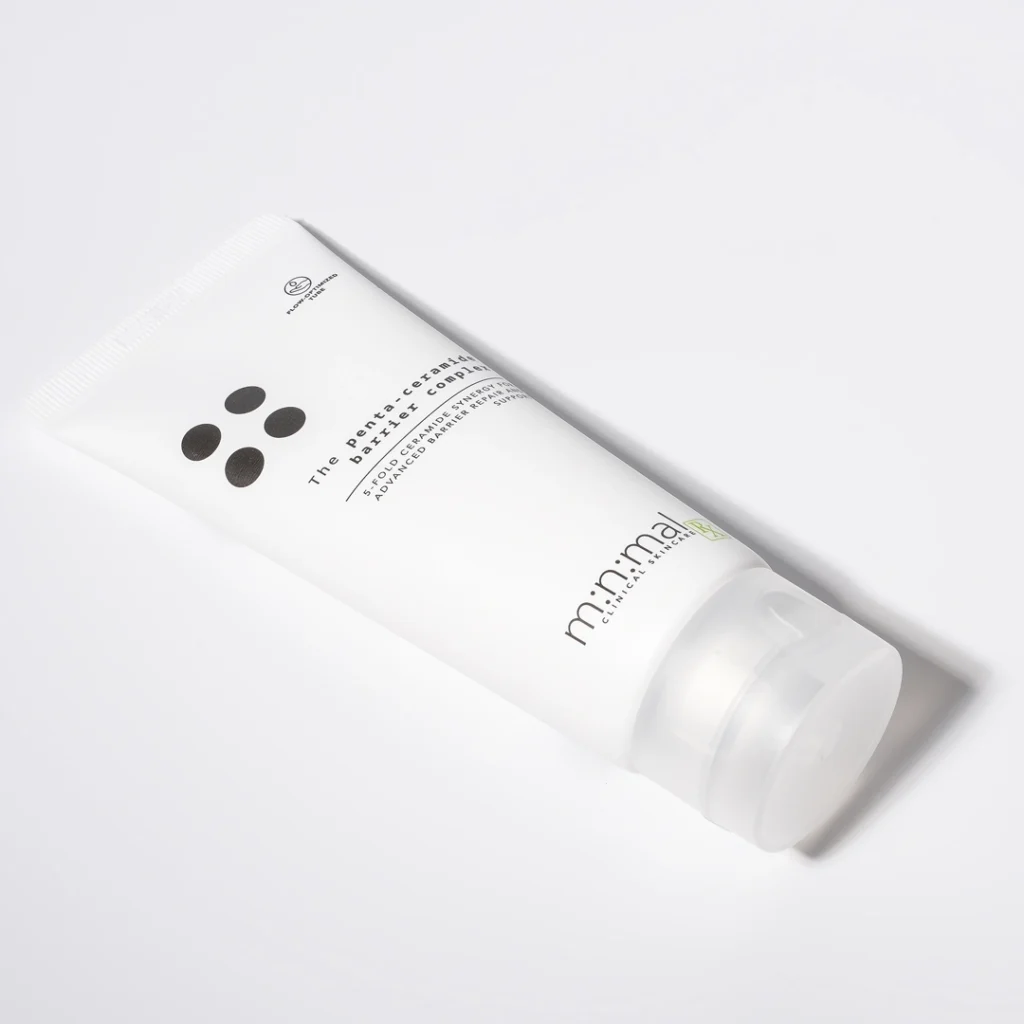
Your skin barrier is only a fraction of a millimetre thick, yet it decides how much water you keep and how much irritation gets in. Most of its strength comes from lipids, and about half of those lipids are ceramides.
Bricks and mortar
The outer layer of skin, the stratum corneum, works like a brick wall. The bricks are flattened dead skin cells. The mortar is a lipid mix of roughly half ceramides, a quarter cholesterol and about a tenth to a sixth free fatty acids.
When the mortar thins, water escapes and irritants get in. Skin feels tight, stings with products that never bothered it, and flakes.
Why five ceramides, not one
Ceramides are a family, named by their building blocks. Each type packs into the barrier slightly differently.
| Ceramide | Built from | Role in the barrier |
|---|---|---|
| NP | Phytosphingosine + non-hydroxy fatty acid | One of the most abundant; core structure |
| NS | Sphingosine + non-hydroxy fatty acid | Core structure |
| AS | Sphingosine + alpha-hydroxy fatty acid | Helps order the lipid layers |
| AP | Phytosphingosine + alpha-hydroxy fatty acid | Helps order the lipid layers |
| EOP | Phytosphingosine + very long esterified fatty acid | Links layers together; key for tight packing |
Penta-Ceramide Barrier Complex contains all five. Ceramide EOP is the rarest in skincare and one of the most important for barrier organisation.
Why cholesterol matters too
Barrier research found that ceramides work best alongside cholesterol and fatty acids, in proportions close to the skin’s own. Incomplete mixtures helped less and could even slow recovery. So Penta-Ceramide pairs its ceramides with cholesterol, and adds plant lipids (shea butter, squalane and triglycerides) to replenish the barrier.
A hyaluronic complex draws water into the upper skin, and the restored lipids help hold it there.
Signs your barrier needs support
- Tightness after cleansing
- Stinging from products that used to feel fine
- Flaking, or an ashy, dull look on deeper skin tones, where redness can be hard to see
- New breakouts or sensitivity during strong treatments such as vitamin C or exfoliating acids
How to use it
Use a pea-sized amount morning and evening, after serums and before sunscreen. For dry skin, apply a second thin layer once the first has absorbed.
Further reading
- Man MQ, Feingold KR, Thornfeldt CR, Elias PM. Optimization of physiological lipid mixtures for barrier repair. J Invest Dermatol. 1996;106(5):1096–1101.
